 NIWA - Metadata Catalogue
Keyword
River
6 record(s)
Type of resources
Topics
Keywords
Contact for the resource
Provided by
Years
Formats
Representation types
Update frequencies
Status
Scale
-
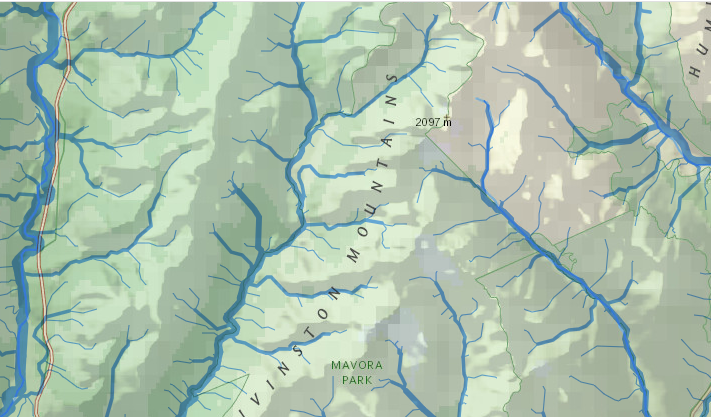
NIWA REC 2v5 (River Environment Classification) The REC has been used to classify all the rivers of New Zealand at a 1:50,000 mapping scale. The area classified comprises 267,000 km2 and 426,000 km of river network. This datasets is for the River Lines. Attributes associated directly with network: Field - Type - Description: Catarea Real Watershed area in m2 CUM_Area Real Area upstream of a reach (and including this reach area) in m2. Nzsegment Integer Reach identifier to be used with REC2 (supersedes nzreach in REC1). nz_fnode Integer Unique number of preceding river segment's outlet node. nz_tnode Integer Unique number of following river segment's inlet node. Lengthdown RealThe distance to coast from any reach to its outlet reach, where the river drains (m). Headwater Integer Number (0) denoting whether a stream is a “source” (headwater) stream. Non-zero for non-headwater streams. Hydseq Integer A unique number denoting the hydrological processing order of a river segment relative to others in the newtork. StreamOrder Integer A number describing the Strahler order a reach in a network of reaches. euclid_dist Real The straight line distance of a reach from the reach “inlet” to its “outlet”. upElev Real Height (asl) of the upstream end of a reach section in a watershed (m). downElev Real Height (asl) of the downstream end of a reach section in a watershed (m). upcoordX Real Easting of the upstream end of a river segment in m (NZTM2000). upcoordY Real Northing of the upstream end of a river segment in m (NZTM2000). downcoordX Real Easting of the downstream end of a river segment in m (NZTM2000). downcoordY Real Northing of the downstream end of a river segment in m (NZTM2000). sinuosityReal Actual distance divided by the straight line distance giving the degree of curvature of the stream nzreach_rec1 IntegerThe REC1 identifiying number for the corresponding\closest reach from REC1 (can be used to retrieve the REC management classes) headw_dist Integer Distance of the furthermost “source” or headwater reach from any reach (m). Shape_length RealThe length of the reach (vector) as calculated by ArcGIS. Segslpmax Real Maximum segment slope along length of reach. Segslpmean Real Mean segment slope along length of reach. LID Integer Lake Identifier number(LID) of overlapping lake. Reachtype Integer A value of 2 is assigned if the segment is an outlet to the lake, otherwise 0 or null. nextdownid integer segment number of the most downstream reach
-
Field Description: NZReach Unique national identifier ReachID Unique regional identifier Tnode To node – used for network directionFnode From node – used for network direction Length Length of river section (m )Climate Climate level classCSoF Source-of-Flow level classCSoFG Geology level classCSoFGL Land-Cover level classCSoFGLNP Network-Position level classCSoFGLNPVL Valley-Landform level classSrc_of_flw Source-of-Flow factor category Geology Geology factor categoryLandcover Land-Cover factor categoryNet_posn Network-Position factor categoryVly_Lfrm Valley-Landform factor categoryOrder Stream order The Field "NZREACH" is the unique field used for joining to all other REC1 data that is available, but not included in the variables above.
-
Field Description: NZReach Unique national identifierReachID Unique regional identifierTnode To node – used for network direction Fnode From node – used for network directionLength Length of river section (m)Climate Climate level classCSoF Source-of-Flow level classCSoFG Geology level classCSoFGL Land-Cover level classCSoFGLNP Network-Position level classCSoFGLNPVL Valley-Landform level classSrc_of_flw Source-of-Flow factor category Geology Geology factor category Landcover Land-Cover factor category Net_posn Network-Position factor categoryVly_Lfrm Valley-Landform factor categoryOrder Stream order The Field "NZREACH" is the unique field used for joining to all other REC1 data that is available, but not included in the variables above.
-
This layer is based on the New Zealand River Environment Classification REC2 V5 and describes the larger catchments of New Zealand that are a Strahler order five and greater. It also has the associated names that belong to the parent sea draining catchment. It was originally derived by dissolving local Strahler Order 1 watersheds. REC2 (River Environment Classification, v2.5) - June 2019 [Hosted Feature Layer]This service depicts catchments as polygons The River Environment Classification (REC) is a database of catchment spatial attributes, summarised for every segment in New Zealand's network of rivers. The attributes were compiled for the purposes of river classification, while the river network description has been used to underpin models. Typically, models (e.g. CLUES and TopNet) would use the dendritic (branched) linkages of REC river segments to perform their calculations. Since its release and use over the last decade, some errors in the location and connectivity of these linkages have been identified. The current revision corrects those errors, and updates a number of spatial attributes with the latest data. REC2 provides a re-cut framework of rivers for modelling and classification. It is built on a newer version of the 30m digital elevation model, in which the original 20m contours were supplemented with, for example, more spot elevation data and a better coastline contour. Boundary errors were minimised by processing contiguous areas (such as the whole of the North Island) together, which wasn't possible when it was originally created.Major updates include the revision of catchment land use information, by overlaying with the land cover database (LCDB3, current as at 2008), and the update of river and rainfall statistics with data from 1960-2006. The river network and associated attributes have been assembled within an ArcGIS geodatabase. Topological connectivity has been established to allow upstream and downstream tracing within the network. This is based on REC2 (Version 5) , June 2019 - a publicly available dataset from NIWA Taihoro Nukurangi.NIWA acknowledges funding from the MBIE SSIF towards the preparation of REC v2.5Coordinate Reference System: NZTM (New Zealand Transverse Mercator, EPSG: 2193) Geometric Representation of Rivers: Lines Geometric Representation of Catchments: Polygons Extent (Bounding Box): Top(Latitude) -33.9534Bottom(Latitude) -47.4867 Left (Longitude) 166.2634 Right (Longitude) 178.9733 Available Fields: Shape,FID_1,diss,FID_2,HydroID,CATAREA,CUM_AREA,nzsegment,StreamOrde,upElev,downElev,upcoordX_1,downcoor_1,downcoor_2,upcoordY_1,RivName,Distance,ord_diff,Distance_1,Shape_Length,Shape_Area
-
A map service and web application where users can extract flood statistics from a regional flood model, at-site flood statistics and annual maximum flows from flow recorders used in the model development, flood estimates based on rain intensity for use in the Rational Method. 1. Modelled flood frequency estimates on river lines. NZREACH NZ digital network 1 ID no. River name where available Area km2 catchment area draining to the downstream end of this reach (square kilometres)q100_reach ratio of Q100 (1% aep flood) to mean annual flood C18_MAF mean annual flood (cumecs) C18_5-yr 5-yr (20% aep) flood (cumecs) C18_10y 10-yr (10% aep) flood (cumecs) C18_20y 20-yr (5% aep) flood (cumecs) C18_50y 50-yr (2% aep) flood (cumecs) C18_100y 100-yr (1% aep) flood (cumecs) C18_1000y 1000-yr (0.1% aep) flood (cumecs) HCse_MAF standard error of mean annual flood (cumecs) HCse_5y standard error of 5-yr (20% aep) flood (cumecs) HCse_10y standard error of 10-yr (10% aep) flood (cumecs) HCse_20y standard error of 20-yr (5% aep) flood (cumecs) HCse_50y standard error of 50-yr (2% aep) flood (cumecs) HCse_100y standard error of 100-yr (1% aep) flood (cumecs) HCse_1000y standard error of 1000-yr (0.1% aep) flood (cumecs) Strm_Order Strahler stream order (1=headwater, two ones join to make an order 2, etc.) 2. At-site flood statistics at flow recorders used in the model development Siteno NIWA reference number for flow recorder Name Flow recorder name generally 'river' at 'location' NZTM_E NZTM easting NZTM_N NZTM northing Region Regional council or unitary authority territory Operator Organisation that operates the flow recorder Funder Organisation that funds the flow recorder (can be more than one)Area_km2 catchment area draining to the flow recorder (square kilometers) No_years Number of years in the annual flood series (allowing for years with missing data) L1_mean Mean of the annual flood series (linear moment 1)L2 Linear moment 2 of the annual flood series (analogous to standard deviation)Lcv Linear CV of the annual flood series (L2/L1) T3_Lskew Linear skew ratio of the annual flood series T4_Lkurt Linear kurtosis ratio of the annual flood series Gumb_u Gumbel distribution u of the annual flood series Gumb_alpha Gumbel distribution alpha of the annual flood series GEV_u Generalised Extreme Value u of the annual flood seriesGEV_alpha Generalised Extreme Value alpha of the annual flood series GEV_k Generalised Extreme Value k of the annual flood series GEV_z Hosking-Wallis normal standard variate to test significance of GEV-k (is the at-site distribution Gumbel or not?)Data 2.33y mean annual flood (2.33-yr assuming Gumbel, or 43% aep) Data 5y 5-yr (20% aep) flood (cumecs)Data 10y 10-yr (10% aep) flood (cumecs) Data 20y 20-yr (5% aep) flood (cumecs)Data 50y 50-yr (2% aep) flood (cumecs) Data 100y 100-yr (1% aep) flood (cumecs)Data 250y 250-yr (0.4% aep) flood (cumecs) Data 500y 500-yr (0.2% aep) flood (cumecs) Data 1000y 1000-yr (0.1% aep) flood (cumecs) se_2.33y standard error of mean annual flood (%) se_5y standard error of 5-yr (20% aep) flood (%) se_10y standard error of 10-yr (10% aep) flood (%)se_20y standard error of 20-yr (5% aep) flood (%) se_50y standard error of 50-yr (2% aep) flood (%) se_100y standard error of 100-yr (1% aep) flood (%) se_250y standard error of 250-yr (0.4% aep) flood (%) se_500y standard error of 500-yr (0.2% aep) flood (%) se_1000y standard error of 1000-yr (0.1% aep) flood (%) 3. Return period estimates of the area-rain intensity values for small catchments. Where results display '-1' the catchment is greater than 30 square kilometres and no answer is available. Numbers need to be multiplied by the Rational Method 'C' factor to give the required flood magnitude. NZREACH NZ digital network 1 ID no. AREA_km2 catchment area draining to the flow recorder (square kilometers) QIA_5y 5-yr (20% aep) IA estimateQIA_10y 10-yr (10% aep) IA estimate QIA_20y 20-yr (5% aep) IA estimateQIA_50y 50-yr (2% aep) IA estimateQIA_100y 100-yr (1% aep) IA estimate QIA_1000y 1000-yr (0.1% aep) IA estimate 4. Annual data values at flow recorders used in the model development. Owner: NIWA_OpenData
-
The New Zealand Land Cover Database (LCDB) is a multi-temporal, thematic classification of New Zealand's land cover. It contains 33 mainland classes (35 including the offshore Chatham Islands). The classification has evolved from version to version but backward compatibility has been maintained. Geographic features are described by a polygon boundary, a land cover code, and a land cover name at each of four nominal time steps; summer 1996/97, summer 2001/02, summer 2008/09, and summer 2012/13. The data set is designed to complement in theme, scale and accuracy, Land Information New Zealand’s 1:50,000 topographic database. LCDB is suitable for use in national and regional state-of-environment monitoring, forest and shrubland inventory, biodiversity assessment, trend analysis and infrastructure planning. The classification used in LCDB v4.1 is presented in the document 'LCDBClassesAtVersion4.1.pdf' and a table correlating LCDB classes over all four LCDB versions is presented in the document 'LCDBClassCorrelations.pdf'. Both of these documents are available as an attachment to this dataset in the LRIS portal (https://lris.scinfo.org.nz/) and on the LCDB project site (www.lcdb.scinfo.org.nz). LCDB v4.1 was released in July 2015 and includes corrections to all time steps 1996/97, 2001/02, 2008/09 and 2012/13. A description of work undertaken for this release (including that in all earlier releases) is presented in the Lineage section. Of particular note at 4.1 is the re-mapping of Chatham Islands - first mapped at version 2, but then not continued through versions 3.0, 3.3, and 4.0 because of resource constraints. “EditAuthority” and "EditDate" are attributes, maintained since version 3.0 to indicate authorship and nominal date of polygon mapping, edit or change. The data is referenced to the New Zealand Transverse Mercator 2000 projection (NZTM2000) which uses the NZ Geodetic Datum 2000 (NZGD2000). https://koordinates.com/from/lris.scinfo.org.nz/layer/48423/Errors in the data due to misclassification (not changes since mapping) or poor delineation can be reported to Landcare Research for inclusion in the next release using the online feedback mechanisms in https://lris.scinfo.org.nz/.