 NIWA - Metadata Catalogue
Keyword
Inland waters
21 record(s)
Type of resources
Topics
Keywords
Contact for the resource
Provided by
Years
Formats
Representation types
Update frequencies
Status
Scale
Resolution
-
Attributes associated directly with network:FieldTypeDescriptionCatareaRealWatershed area in m2CUM_Area RealArea upstream of a reach (and including this reach area) in m2.NzsegmentIntegerReach identifier to be used with REC2 (supercedes nzreach in REC1).nz_fnodeIntegerUnique number of preceding river segment's outlet node.nz_tnodeIntegerUnique number of following river segment's inlet node.LengthdownRealThe distance to coast from any reach to its outlet reach, where the river drains (m).HeadwaterIntegerNumber (0) denoting whether a stream is a “source” (headwater) stream. Non-zero for non-headwater streams.HydseqIntegerA unique number denoting the hydrological processing order of a river segment relative to others in the newtork.StreamOrderIntegerA number describing the Strahler order a reach in a network of reaches.euclid_distRealThe straight line distance of a reach from the reach “inlet” to its “outlet”.upElevRealHeight (asl) of the upstream end of a reach section in a watershed (m).downElevRealHeight (asl) of the downstream end of a reach section in a watershed (m).upcoordXRealEasting of the upstream end of a river segment in m (NZTM2000).upcoordYRealNorthing of the upstream end of a river segment in m (NZTM2000).downcoordXRealEasting of the downstream end of a river segment in m (NZTM2000).downcoordYRealNorthing of the downstream end of a river segment in m (NZTM2000).sinuosityRealActual distance divided by the straight line distancegiving the degree of curvature of the streamnzreach_rec1IntegerThe REC1 identifiying number for the corresponding\closest reach from REC1 (can be used to retrieve the REC management classes)headw_distIntegerDistance of the furthermost “source” or headwater reach from any reach (m).Shape_lengthRealThe length of the reach (vector) as calculated by ArcGIS.SegslpmaxRealMaximum segment slope along length of reach.SegslpmeanRealMean segment slope along length of reach.LIDIntegerLake Identifier number(LID) of overlapping lake.ReachtypeIntegerA value of 2 is assigned if the segment is an outlet to the lake, otherwise 0 or null.nextdownidintegersegment number of the most downstream reach
-
The REC has been used to classify all the rivers of New Zealand at a 1:50,000 mapping scale. The area classified comprises 267,000 km2 and 426,000 km of river network. The important attributes are nzsegment (primary key), which can be used to join the watershed polygons to the river network, and the old_nzreach (which can be used to retrieve values from REC1 river classification, and other previously calculated properties). The shape_area gives the area of the watershed in meters squared.
-
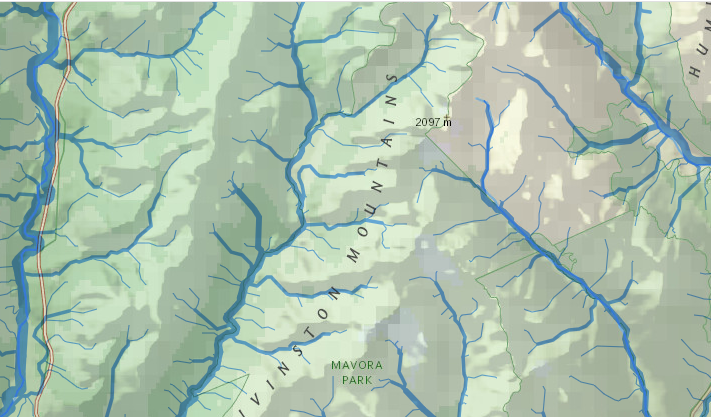
NIWA REC 2v5 (River Environment Classification) The REC has been used to classify all the rivers of New Zealand at a 1:50,000 mapping scale. The area classified comprises 267,000 km2 and 426,000 km of river network. This datasets is for the River Lines. Attributes associated directly with network: Field - Type - Description: Catarea Real Watershed area in m2 CUM_Area Real Area upstream of a reach (and including this reach area) in m2. Nzsegment Integer Reach identifier to be used with REC2 (supersedes nzreach in REC1). nz_fnode Integer Unique number of preceding river segment's outlet node. nz_tnode Integer Unique number of following river segment's inlet node. Lengthdown RealThe distance to coast from any reach to its outlet reach, where the river drains (m). Headwater Integer Number (0) denoting whether a stream is a “source” (headwater) stream. Non-zero for non-headwater streams. Hydseq Integer A unique number denoting the hydrological processing order of a river segment relative to others in the newtork. StreamOrder Integer A number describing the Strahler order a reach in a network of reaches. euclid_dist Real The straight line distance of a reach from the reach “inlet” to its “outlet”. upElev Real Height (asl) of the upstream end of a reach section in a watershed (m). downElev Real Height (asl) of the downstream end of a reach section in a watershed (m). upcoordX Real Easting of the upstream end of a river segment in m (NZTM2000). upcoordY Real Northing of the upstream end of a river segment in m (NZTM2000). downcoordX Real Easting of the downstream end of a river segment in m (NZTM2000). downcoordY Real Northing of the downstream end of a river segment in m (NZTM2000). sinuosityReal Actual distance divided by the straight line distance giving the degree of curvature of the stream nzreach_rec1 IntegerThe REC1 identifiying number for the corresponding\closest reach from REC1 (can be used to retrieve the REC management classes) headw_dist Integer Distance of the furthermost “source” or headwater reach from any reach (m). Shape_length RealThe length of the reach (vector) as calculated by ArcGIS. Segslpmax Real Maximum segment slope along length of reach. Segslpmean Real Mean segment slope along length of reach. LID Integer Lake Identifier number(LID) of overlapping lake. Reachtype Integer A value of 2 is assigned if the segment is an outlet to the lake, otherwise 0 or null. nextdownid integer segment number of the most downstream reach
-
NIWA has published a lake chart for every lake in New Zealand that can be surveyed, except for Lake Dunstan. The charts are of various scales that are determined to be the most appropriate for the size of the lake. The compilation of bathymetry from echo-sounding surveys with publication dates ranging from 1966 to 1989. This dataset also contains newly surveyed bathymetry using multibeam information. New data as and when available shall be added to this dataset. Some of the lakes may have more than one set of bathymetry files. The earlier one could be from the period 1966 to 1989 and the new information from recent surveys undertaken for comparison purposes.
-
The New Zealand Land Cover Database (LCDB) is a multi-temporal, thematic classification of New Zealand's land cover. It identifies 33 mainland land cover classes (35 classes once the offshore Chatham Islands are included). The classification was revised between versions 1, 2, and 3 but has been consistent thereafter, and always with backward compatibility maintained. Land cover features are described by a polygon boundary, a land cover code, and a land cover name at each nominal time step; summer 1996/97, summer 2001/02, summer 2008/09, summer 2012/13, and summer 2018/19. The data set is designed to complement in theme, scale and accuracy, New Zealand’s 1:50,000 topographic database (https://www.linz.govt.nz/land/maps/topographic-maps/topo50-maps). LCDB is suitable for use in national and regional environment monitoring, forest and shrubland inventory, biodiversity assessment, trend analysis and infrastructure planning. The classification used in LCDBv5.0 is presented in the document 'LCDBClassesAtVersion5.pdf' and a table correlating LCDB classes over all versions is presented in the document 'LCDBClassCorrelations.pdf'. Both of these are among the accessory documents to this dataset in the LRIS portal (https://lris.scinfo.org.nz/). LCDB version 5.0 was released in January 2020 and includes corrections to all time steps1997/97, 2001/02, 2008/09, 2012/13 and 2018/19 for both the New Zealand mainland and Chatham Islands. A description of work undertaken for this release (including that of all earlier releases) is presented in the Lineage section. Of particular note at version 5.0 is the addition to LCDB, of attributes designed to readily identify and monitor wetlands over time and a similar capability to manage significant coastal changes. “EditAuthority” and "EditDate" are attributes, maintained since version 3.0 to indicate authorship and nominal date of polygon mapping, edit or change. Errors in the data due to misclassification (rather than land cover change) or poor delineation can be reported to Landcare Research for inclusion in the next release using the online feedback facility in https://lris.scinfo.org.nz/.
-
The REC groups rivers and parts of river networks that share similar ecological characteristics, including physical and biological. Rivers that share the same class can be treated as similar to one another and different to rivers in other classes. The REC classification system groups rivers according to several environmental factors that strongly influence or cause the rivers’ physical and ecological characteristics (climate, topography, geology and land cover). Stream order is the numerical position of a tributary or section of a river within the entire network. Headwater streams are assigned a stream order of 1. When two tributaries of the same stream order meet, the order increments by one for the next section downstream. However, if two sections meet where one section has higher order than the other, the next section downstream has the same order as the highest upstream section.
-
NIWA has published a lake chart for every lake in New Zealand that can be surveyed, except for Lake Dunstan. The charts are of various scales that are determined to be the most appropriate for the size of the lake. The compilation of bathymetry from echo-sounding surveys with publication dates ranging from 1966 to 1989. This dataset also contains newly surveyed bathymetry using multibeam information. New data as and when available shall be added to this dataset. Some of the lakes may have more than one set of bathymetry files. The earlier one could be from the period 1966 to 1989 and the new information from recent surveys undertaken for comparison purposes.
-
[The Place Names Gazetteer](http://www.linz.govt.nz/placenames/find-names/nz-gazetteer-official-names/nzgb-gazetteer) contains **official** and **unofficial** place names under the jurisdiction of the New Zealand Geographic Board Ngā Pou Taunaha o Aotearoa (NZGB). Official place names are those that have been assigned, altered, adopted, approved, and validated under the NZGB Act 2008 or through other statutes that assign official names, for example, Treaty settlement legislation. Unofficial place names are those that have not been processed under the NZGB Act 2008 or through other relevant statutes. Data is extracted from Land Information New Zealand’s (LINZ) ‘New Zealand Gazetteer of Official Geographic Names’, which is maintained by the NZGB Secretariat. Geographical coverage encompasses New Zealand, the Ross Dependency of Antarctica, and the Continental Shelf of New Zealand. The NZGB has naming jurisdiction over: - natural features such as mountains, peaks, valleys, glens, forests, lagoons, swamps, creeks, streams, rivers, fords, lakes, glaciers or ice features, bays, islands or harbours (including man-made features of the same type) - railways or railway stations, but not railway features such as marshalling yards, transfer sites, or track point locations - places, i.e. cities, towns, villages, sites, areas, or similar places, including suburbs and localities - undersea features - Crown protected areas - Districts and regions (altering only if requested by the local authority) Each name is provided with a location represented by a point. More complex geometry (e.g lines for rivers or areas for suburbs) is not currently available. Each geographic feature has one or more place names associated with it. Place names usually comprise two components – ‘specific’, being for the proper noun, and ‘generic’, being a description of the geographic feature type. Information provided for each place name may include: name; name status (whether official or unofficial); geographic feature type; authority by which an official name became official; district within which the name is located; geographic location; reference information; history/origin/meaning; and additional notes. Not all information is available for all names. Positional accuracy is generally the same as 1:50K mapping. Information accuracy reflects information at the time of original capture.
-
NIWA has published a lake chart for every lake in New Zealand that can be surveyed, except for Lake Dunstan. The charts are of various scales that are determined to be the most appropriate for the size of the lake. The compilation of bathymetry from echo-sounding surveys with publication dates ranging from 1966 to 1989. This dataset also contains newly surveyed bathymetry using multibeam information. New data as and when available shall be added to this dataset. Some of the lakes may have more than one set of bathymetry files. The earlier one could be from the period 1966 to 1989 and the new information from recent surveys undertaken for comparison purposes.
-
Field Description: NZReach Unique national identifier ReachID Unique regional identifier Tnode To node – used for network directionFnode From node – used for network direction Length Length of river section (m )Climate Climate level classCSoF Source-of-Flow level classCSoFG Geology level classCSoFGL Land-Cover level classCSoFGLNP Network-Position level classCSoFGLNPVL Valley-Landform level classSrc_of_flw Source-of-Flow factor category Geology Geology factor categoryLandcover Land-Cover factor categoryNet_posn Network-Position factor categoryVly_Lfrm Valley-Landform factor categoryOrder Stream order The Field "NZREACH" is the unique field used for joining to all other REC1 data that is available, but not included in the variables above.